Due to the fact that I am choosing a new project, I need to create a design document to reflect it. This is something that will require a lot of research as well as thought, as I want my RTS version of the game to keep in line with the lore behind the franchise.

So what is an RTS? Real-time strategy (RTS) is a sub-genre of strategy video game which does not progress incrementally in turns. Brett Sperry is credited with coining the term to market Dune II.
In an RTS, as in other wargames, the participants position and maneuver units and structures under their control to secure areas of the map and/or destroy their opponents' assets. In a typical RTS, it is possible to create additional units and structures during the course of a game. This is generally limited by a requirement to expend accumulated resources. These resources are in turn garnered by controlling special points on the map and/or possessing certain types of units and structures devoted to this purpose. More specifically, the typical game of the RTS genre features resource gathering, base building, in-game technological development and indirect control of units.
The tasks a player must perform to succeed at an RTS can be very demanding, and complex user interfaces have evolved to cope with the challenge. Some features have been borrowed from desktop environments; for example, the technique of "clicking and dragging" to select all units under a given area.
Though some game genres share conceptual and gameplay similarities with the RTS template, recognized genres are generally not subsumed as RTS games. For instance, city-building games, construction and management simulations, and games of the real-time tactics variety are generally not considered to be "real-time strategy".
In a typical real-time strategy game, the screen is divided into a map area displaying the game world and terrain, units, and buildings, and an interface overlay containing command and production controls and often a "radar" or "minimap" overview of the entire map. The player is usually given an isometric perspective of the world, or a free-roaming camera from an aerial viewpoint for modern 3D games.
Players mainly scroll the screen and issue commands with the mouse, and may also use keyboard shortcuts.
In most real-time strategy games, especially the earliest ones, the gameplay is generally fast-paced and requires very quick reflexes. For this reason, the amount of violence in some games makes RTS games close to action games in terms of gameplay.
Gameplay generally consists of the player being positioned somewhere in the map with a few units or a building that is capable of building other units/buildings. Often, but not always, the player must build specific structures to unlock more advanced units in the tech tree. Often, but not always, RTS games require the player to build an army (ranging from small squads of no more than 2 units, to literally hundreds of units) and using them to either defend themselves from a virtual form of Human wave attack or to eliminate enemies who possess bases with unit production capacities of their own. Occasionally, RTS games will have a preset number of units for the player to control and do not allow building of additional ones.
Resource gathering is commonly the main focus of the RTS games, but other titles of the genre place higher gameplay significance to the how units are used in combat, the extreme example of which are games of the real-time tactical genre. Some titles impose a ceiling on the number simultaneous troops, which becomes a key gameplay consideration, a significant example being StarCraft, while other titles have no such unit cap.
So what is an RTS? Real-time strategy (RTS) is a sub-genre of strategy video game which does not progress incrementally in turns. Brett Sperry is credited with coining the term to market Dune II.
In an RTS, as in other wargames, the participants position and maneuver units and structures under their control to secure areas of the map and/or destroy their opponents' assets. In a typical RTS, it is possible to create additional units and structures during the course of a game. This is generally limited by a requirement to expend accumulated resources. These resources are in turn garnered by controlling special points on the map and/or possessing certain types of units and structures devoted to this purpose. More specifically, the typical game of the RTS genre features resource gathering, base building, in-game technological development and indirect control of units.
 |
| World In Conflict. |
The tasks a player must perform to succeed at an RTS can be very demanding, and complex user interfaces have evolved to cope with the challenge. Some features have been borrowed from desktop environments; for example, the technique of "clicking and dragging" to select all units under a given area.
Though some game genres share conceptual and gameplay similarities with the RTS template, recognized genres are generally not subsumed as RTS games. For instance, city-building games, construction and management simulations, and games of the real-time tactics variety are generally not considered to be "real-time strategy".
 |
| Company of Heros. |
In a typical real-time strategy game, the screen is divided into a map area displaying the game world and terrain, units, and buildings, and an interface overlay containing command and production controls and often a "radar" or "minimap" overview of the entire map. The player is usually given an isometric perspective of the world, or a free-roaming camera from an aerial viewpoint for modern 3D games.
Players mainly scroll the screen and issue commands with the mouse, and may also use keyboard shortcuts.
In most real-time strategy games, especially the earliest ones, the gameplay is generally fast-paced and requires very quick reflexes. For this reason, the amount of violence in some games makes RTS games close to action games in terms of gameplay.
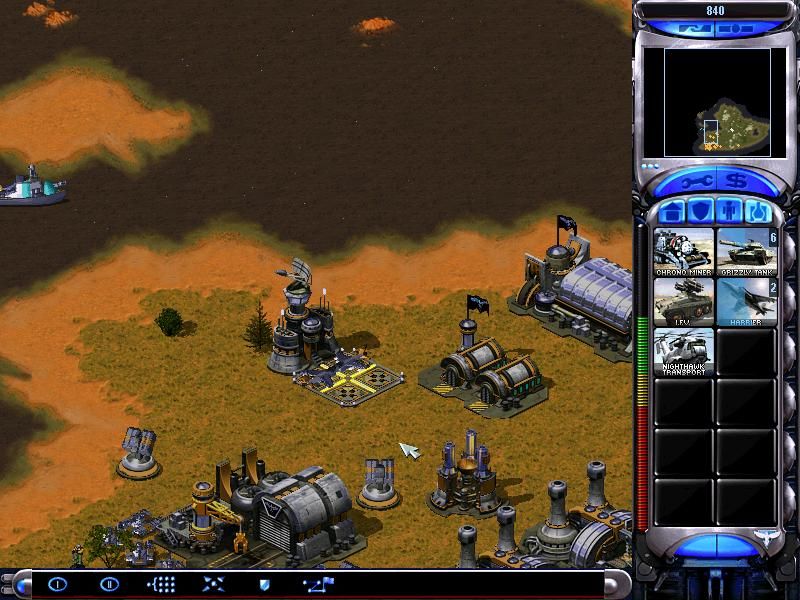 |
| Command & Conquer |
Gameplay generally consists of the player being positioned somewhere in the map with a few units or a building that is capable of building other units/buildings. Often, but not always, the player must build specific structures to unlock more advanced units in the tech tree. Often, but not always, RTS games require the player to build an army (ranging from small squads of no more than 2 units, to literally hundreds of units) and using them to either defend themselves from a virtual form of Human wave attack or to eliminate enemies who possess bases with unit production capacities of their own. Occasionally, RTS games will have a preset number of units for the player to control and do not allow building of additional ones.
 |
| Starcraft. |
Resource gathering is commonly the main focus of the RTS games, but other titles of the genre place higher gameplay significance to the how units are used in combat, the extreme example of which are games of the real-time tactical genre. Some titles impose a ceiling on the number simultaneous troops, which becomes a key gameplay consideration, a significant example being StarCraft, while other titles have no such unit cap.

No comments:
Post a Comment