I've left L.A. Noire till last, as I've actually never played the game. I'm going to be going off of reviews and youtube videos of gameplay, so my analysis might not bas as goof as the others.
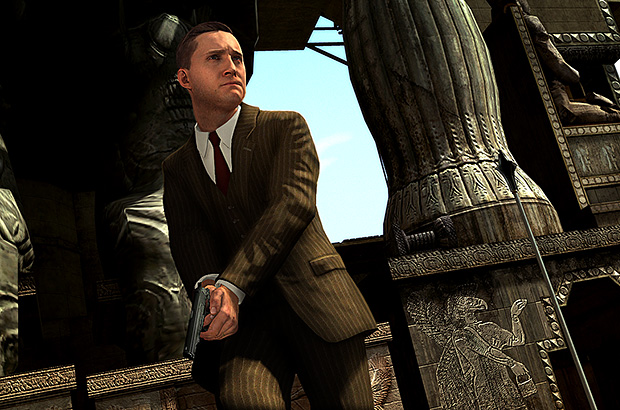
L.A. Noire is a 2011 neo-noir crime video game developed by Team Bondi. Set in Los Angeles in the 1940's, the player is challenged to solve a number of cases across multiple police departments. Players must investigate crime scenes for clues, follow up leads, and interrogate suspects, and the players' success at these activities will impact how much of the cases' stories are revealed. The game draws heavily from both the plot and aesthetic elements of film noir, stylistic films made popular in the 1940s and 1950s that share similar visual styles and themes, including crime and moral ambiguity. The game uses a distinctive colour palette, but in homage to film noir it includes the option to play the game in black and white.
Are players struggling against each other, the game or both?
L.A.Noire is a single player game, eliminating the struggle from player vs player as there is no multiplayer mode. The struggle itself is placed on investigating to gain evidence to solve the games cases, or mysteries. The interrogation mechanic in the game move away from the traditional drip feeding of information to players and replaces it instead with a much more exciting and detailed form of play. The player is required to engage actively in the game, making their own decisions on how and where to engage in the narrative side, which depending on their decisions makes an impact on how the game narative is presented.
What are the interactive experiences provided for players in the game?
The player can freely interact with the crime scene area to find evidence or clues, these are interactive for the player because they get to move around and search freely without the game telling them exactly what to do. The game adapts to the players play style

Does interaction create meaningful play?
The player is made to felt unique and special, as the narrative cannot resolve itself without the players input. The players perception becomes an important part of the narrative, as they player themselves are tasked to reveal the narrative and solve the crime.
What does the game look like?
When I saw the trailers and some of the gameplay, the Grand Theft Auto series sprung to mind, which isn't surprising as both L.A. Noire and GTA are produced by Rocktsar Games. Looking deeper in to the visuals of the game you can clearly see that it takes heavy influences from the film Noir. The large maps allow players to explore the detail rich environment.


Every detail, down to the cars, the clothing, the accents and even the laws of the time have been hit on the head. Players can drive around in over 100 different cars (DLC included) ranging from shabby little motors to elegant powerful cars.
What are the possible visual influences and intertextual references?
I typed in to google "Influences of L.A. Noire", and would you believe it, there was a whole article on it! The article lists movies, television shows, music, authors and even locations. Below are some of the the findings:
Sweet Smell of Success:
Sweet Smell of Success is a 1957 American film made by Hill-Hecht-Lancaster Productions and released by United Artists. It was directed by Alexander Mackendrick and stars Burt Lancaster, Tony Curtis, Susan Harrison and Martin Milner. The screenplay was written by Clifford Odets, Ernest Lehman and Mackendrick from the novelette by Lehman. Mary Grant designed the film's costumes. The film tells the story of powerful newspaper columnist J.J. Hunsecker (portrayed by Lancaster and clearly based on Walter Winchell) who uses his connections to ruin his sister's relationship with a man he deems inappropriate.

Out of the Past:
Out of the Past (originally released in the United Kingdom as Build My Gallows High) is a 1947 film noir directed by Jacques Tourneur and starring Robert Mitchum, Jane Greer and Kirk Douglas. The film was adapted by Daniel Mainwaring (using the pseudonym Geoffrey Homes), with uncredited revisions by Frank Fenton and James M. Cain, from his novel Build My Gallows High (also written as Homes). Film historians consider the film a superb example of film noir due to its convoluted, dark storyline, dark cinematography and classic femme fatale. The film's cinematographer Nicholas Musuraca also shot Tourneur's Cat People. In 1991, Out of the Past was added to the United States National Film Registry as being deemed "culturally, historically, or aesthetically significant."

Badge 714:
The player is made to felt unique and special, as the narrative cannot resolve itself without the players input. The players perception becomes an important part of the narrative, as they player themselves are tasked to reveal the narrative and solve the crime.
What does the game look like?
When I saw the trailers and some of the gameplay, the Grand Theft Auto series sprung to mind, which isn't surprising as both L.A. Noire and GTA are produced by Rocktsar Games. Looking deeper in to the visuals of the game you can clearly see that it takes heavy influences from the film Noir. The large maps allow players to explore the detail rich environment.
Every detail, down to the cars, the clothing, the accents and even the laws of the time have been hit on the head. Players can drive around in over 100 different cars (DLC included) ranging from shabby little motors to elegant powerful cars.
 |
| The Stout. |
 |
| The Voisin. |
I typed in to google "Influences of L.A. Noire", and would you believe it, there was a whole article on it! The article lists movies, television shows, music, authors and even locations. Below are some of the the findings:
Sweet Smell of Success:
Sweet Smell of Success is a 1957 American film made by Hill-Hecht-Lancaster Productions and released by United Artists. It was directed by Alexander Mackendrick and stars Burt Lancaster, Tony Curtis, Susan Harrison and Martin Milner. The screenplay was written by Clifford Odets, Ernest Lehman and Mackendrick from the novelette by Lehman. Mary Grant designed the film's costumes. The film tells the story of powerful newspaper columnist J.J. Hunsecker (portrayed by Lancaster and clearly based on Walter Winchell) who uses his connections to ruin his sister's relationship with a man he deems inappropriate.
Out of the Past:
Out of the Past (originally released in the United Kingdom as Build My Gallows High) is a 1947 film noir directed by Jacques Tourneur and starring Robert Mitchum, Jane Greer and Kirk Douglas. The film was adapted by Daniel Mainwaring (using the pseudonym Geoffrey Homes), with uncredited revisions by Frank Fenton and James M. Cain, from his novel Build My Gallows High (also written as Homes). Film historians consider the film a superb example of film noir due to its convoluted, dark storyline, dark cinematography and classic femme fatale. The film's cinematographer Nicholas Musuraca also shot Tourneur's Cat People. In 1991, Out of the Past was added to the United States National Film Registry as being deemed "culturally, historically, or aesthetically significant."
Badge 714 was a radio series and TV show from actor and writer Jack Webb, the TV show (also known as Dragnet) chronicled real life on the force and re-created the image of the LAPD. I have an old copy of the novel on my desk.

Naked City:Naked City is a police drama series which aired from 1958 to 1963 on the ABC television network. It was inspired by the 1948 motion picture of the same name, and mimics its dramatic “semi-documentary” format.

What other aesthetic qualities does the game present - movement, sound?
I mentioned above that players have a choice of over 100 cards to drive around in, as well as the richly detailed environment. Players can explore their surroundings in a classy looking car, exploring the beauty of a very well made game. The sound used within the game is smooth, sleek, much like the high end cars that the player drives around in. The mixture of the environment, character detail and sound all come together in a beautiful piece of work, inviting the player to immerse themselves back in to the 1940's to act out their part as a detective.
Consider the game in terms of context, origin, year of manufacture, company, target audience, does the game contain any persuasive purpose, what would make the game more effective and what potentials does the game point to?
The effectiveness of this game is almost absolute. The amount of detail put into making this game incredibly interactive shines throughout, and the classic 1940s feel to the game puts you right in the midst of the action. Without actually playing the game, I do not feel comfortable with saying much more.

No comments:
Post a Comment